Leading Ladies
For most of us, uploading footage of ourselves doing the Floss might be unwise, but never criminal. We should count ourselves lucky. When Maedeh Hojabri posted some fairly vanilla clips of herself dancing in her bedroom, she managed to inflame the strict Islamic government of her home country, Iran. There, dancing is immoral and illegal in public for women. Along with a handful of other young Iranian women, Maedeh was arrested this July and forced to issue a “confession” on state television.
Soon social media was awash with messages of support for Maedeh’s case, trending under hashtags like #dancingisnotacrime. Just like #metoo, Maedeh’s case sparked a huge wave of female solidarity. A women’s movement focused on women’s right to move. Dancing has always been fun, but when the moves are generated by a female body, there is always politics involved, too. Around the globe and across all cultures, from reproductive rights to sex harassment to the simplest dance moves, women’s bodies are, as much as ever, a site of tense political contention.
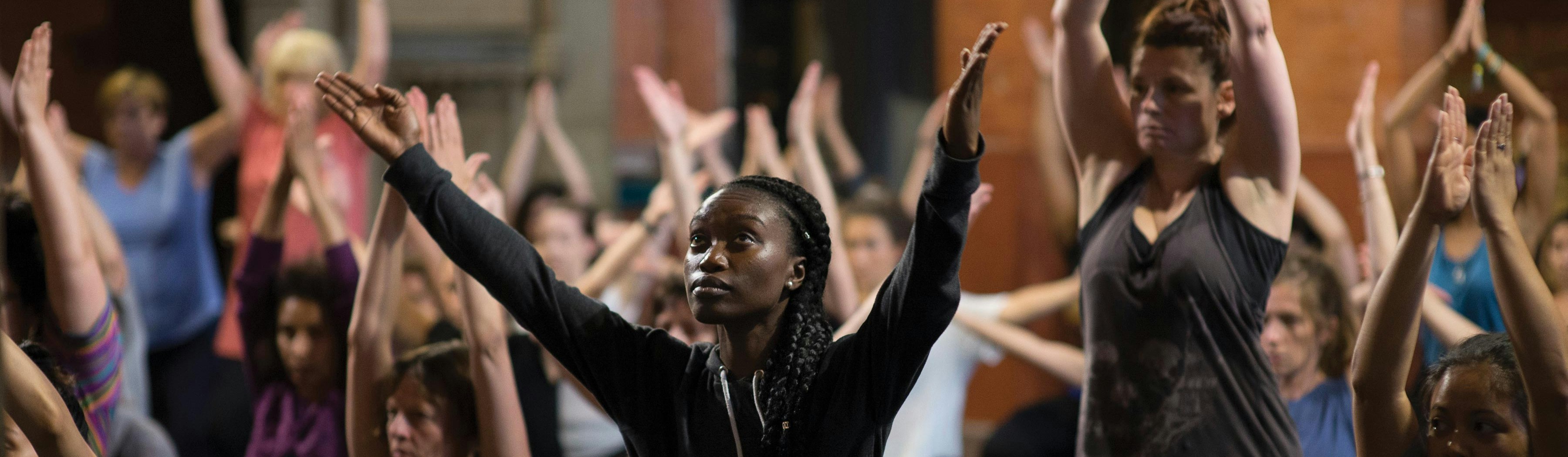
This September, choreographer Sasha Milavic Davies and 200 female performers bring their homage to women’s movement to Greenwich Peninsula. Programmed as part of this year’s Dance Umbrella festival, Everything That Rises Must Dance encapsulates women’s empowerment through motion. Professional dancers and community participants dance together as a sea of movement. They bend, turn, wave, slump and fold, moving both in unison, and independently, as a cacophony of gestures. The dance is, in turns, delicate, bold, angry, urgent and joyous. It is emphatically female.


In making the work, Milavic Davies invited participants to create their own choreography, based on gestures they had seen other women doing in daily life. So Everything That Rises Must Dance has collective, shared ownership among the women who perform it, and gives a physical voice to women’s everyday movements.
Yet, dance has always been inherently feminist. It’s a female-dominated art form, largely created by pioneering women; an art form that continues to push at and play with notions of femininity and masculinity. It was two women who created the British ballet industry and grew it into a world-class art form during the first half of the 20th century. Marie Rambert founded Britain’s first ballet company, Rambert. Ninette de Valois founded the Royal Ballet, the Birmingham Royal Ballet and the Royal Ballet School. The subsequent history of ballet is somewhat chequered. The prominence of male choreographers manipulating female dancing bodies has led to rather too many tragic heroines on stage and a few notorious stories of Black Swan-style emotional and sexual abuse off it. However, things are now changing in all respects, with more empowered female dancers such as Natalia Osipova, and more opportunities for female choreographers from female artistic directors such as Tamara Rojo at English National Ballet.
“The importance of the dancer’s own body is central to understanding dance as part of feminism – female dance artists “are” their art form; their self-expression is their message.”
But equally, since its earliest decades, there were female dancers who didn’t fit the strict feminine mystique of ballet. They decided to dance their own steps instead. Dancers like Isadora Duncan, who wafted around in bare feet and loose, billowing dresses, scandalising and delighting Victorian society with her wanton, womanly moves. Dancers like Martha Graham, who fundamentally connected dance to breath and emotion, and whose techniques are still taught to all contemporary dance students today. Dancers like Josephine Baker, who used her sexuality and “exoticism” on her own terms to become the most celebrated act at Paris’s Folies Bergère and the first person of colour to gain worldwide success as an entertainer. Baker campaigned for civil rights and aided the French Resistance movement during the second world war.
The importance of the dancer’s own body is central to understanding dance as part of feminism – female dance artists “are” their art form; their self-expression is their message. Also central is the rejection or reclamation of prevailing ideas of femininity and sexuality, whether it’s a conscious concern or a subtext of the work. So, in the 1960s and 70s, postmodern choreographers like Trisha Brown in the States, or Siobhan Davies here in the UK, stripped movement back to basics. More recent decades have seen the rise of gay and trans rights, women’s full entrance into working culture, shared parenting, new men, and a general throwing in the air of stereotypical gendered identity. In dance, too, gender divisions have crumbled away. Boys do ballet, girls do hip-hop. In the ultra-cool world of commercial dance, hyper-sexualised “femme” choreography is as likely to be created and danced by men (like Britain’s Got Talent finalist Yanis Marshall) as by women, with both sexes often donning huge platform heels to perform.


In pop culture, female artists use their dance moves to define and distinguish themselves, both on stage and in music videos. Some – Madonna, Beyoncé, Rihanna, Nicky Minaj – are proudly provocative and sexual. Others – Janelle Monáe, Christine and the Queens, Janet Jackson in Rhythm Nation – deliberately cover themselves and use elaborately choreographed androgyny. Still others – Kate Bush, Lady Gaga – create wild fantastical characters, costumes and movements. Female solidarity and girls dancing together feature in two current hit videos – Dua Lipa’s anthemic New Rules, and Monáe’s PYNK (where she swaps her previous monochrome suited look for pink chaps). These videos and songs are shout-outs to women to think, move and dance for themselves.
Female choreographers have ridden the crest of this gender-bending wave. The work of German choreographer Pina Bausch stripped back men’s and women’s egos to the most basic human emotions of needing to belong and be loved, daring to show men as vulnerable, needy and scared. In the current UK contemporary dance scene, Rosie Kay’s award-winning 5 Soldiers follows male and female soldiers training for combat. Kloe Dean explores male suicide in her hip-hop theatre work. Charlotte Vincent strips back modern masculinity in her current show, Shut Down. Sadler’s Wells associate Kate Prince directed Some Like It Hip Hop, its story set in a fictionalised world where women cross-dress to gain access to the privileged world of men. My own dance work turns traditional “love duets” on their head, swapping roles and choreography, so men embrace softer dancing and are lifted by women.
“So whether it’s fighting for basic women’s rights, a rallying call to unity, a means of self-expression, reclaiming sexuality or subverting expected gender norms, the answer is the same.”
Many female dance-makers are also interested in promoting female solidarity through sharing their work and encouraging all women to join in the dance. Nelken Line, where a section of choreography from the Bausch show is learnt online, then recreated in towns and cities across the world by hundreds of amateur participants, brings women together in acts of uplifting collective performance. And when Beyoncé “borrowed” sections of choreography from German dance-maker Anne Teresa de Keersmaeker for her music video for Countdown, De Keersmaeker didn’t respond with a lawsuit, but an invitation to female dancers across the world to post their own versions of her dance online.
So whether it’s fighting for basic women’s rights, a rallying call to unity, a means of self-expression, reclaiming sexuality or subverting expected gender norms, the answer is the same – just dance.