Pattern Recognition
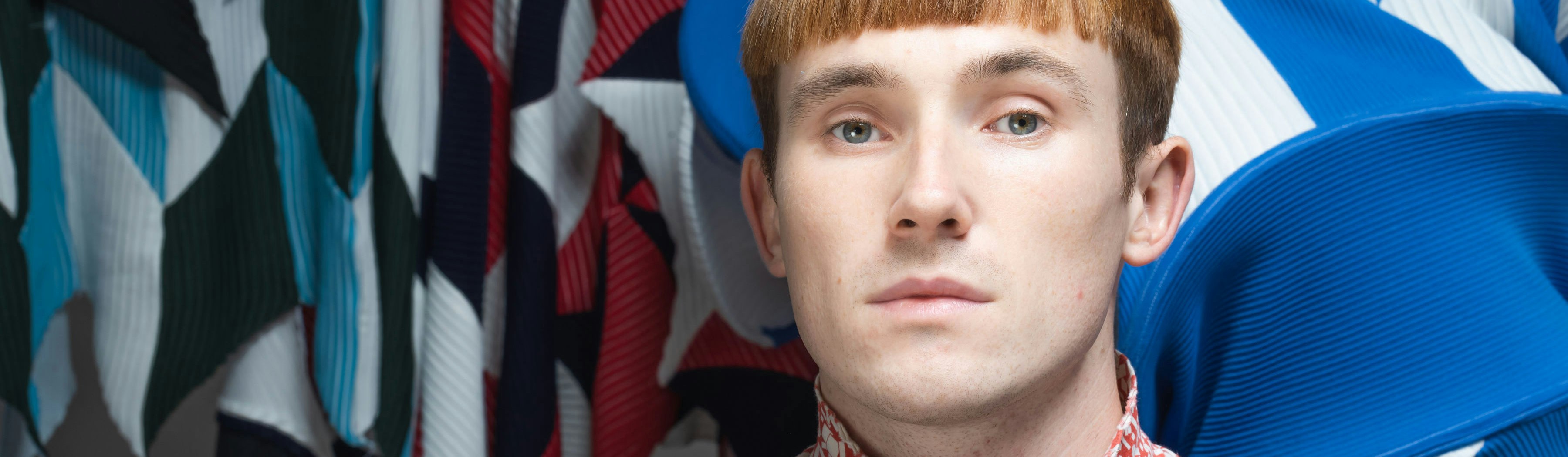
Though only a few years out of college, Richard Malone is widely recognised as one of the most promising fashion designers of his generation. He tells Alex Rayner how market-stall holders and building-site signs helped him on his way.
As a child, Richard Malone admired the leading ladies of Hollywood. Not Hollywood, California, though, but Hollywood, the rural market town in County Wicklow, about an hour and a half north of Malone's childhood home in Wexford, on the east coast of Ireland.
“It's between Dublin and Wexford, if you take the route that doesn’t go via the main road,” says the 28-year-old designer, seated in his studio in north London. “They sell cows and sheep and occasionally stolen goods. It’s your standard rural market.” The wares on display didn’t interest young Richard; he was more taken with the remarkably impressive Hollywood women behind the stalls. “I got to know some of them through my grandmother’s friends and my aunts,” he recalls. “They cared about the way they looked. When you’re in a working-class community, there’s a real effort that goes into presenting yourself.”

Their clothing might not look especially impressive to an unobservant onlooker. The women, he says, might have sported head wraps, for example. It was more the effect their style of dress had on their clientele. “The customers would be slightly afraid of them,” Malone recalls. “The clothes they wore empowered them. By dressing a certain way, by looking impressive, they were able to do a better job.”
That’s a remarkable observation for a young boy to make, but then Malone is pretty remarkable any way you look at it. He comes from a modest background (his mother worked in Argos; his dad is a painter and decorator), yet won the LVMH Grand Prix scholarship during his final year at Central St Martins; his 2014 graduate collection was also given the Deutsche Bank Award for Fashion, and was bought up, in its entirety, by the Brown Thomas department store, Dublin’s answer to Selfridges.
“It’s between dublin and wexford. They sell cows and sheep and occasionally stolen goods. It’s your standard rural market.”

Since then, he’s received awards from the British Fashion Council, praise from Vogue, Dazed & Confused and Another Magazine, and had his work added to the Museum of Modern Art’s permanent collection in New York.
Yet, up until his final year at St Martins, he had been thinking about abandoning fashion altogether, to study sculpture at London’s Royal Academy. “But then I won a big prize, and got funding to start my own label,” he laughs, “so I thought I had to do that.”
Malone says some of his nascent creative forays involved him fooling around with his dad’s work supplies. “I was surrounded by masonry paint and Polyfilla,” he says. “I was quite interested in that for a while.” Art galleries were in as short a supply as catwalk shows in Richard’s home town, yet the differences between his mother’s clothes, his dad’s workwear, and his own school uniform intrigued him. Mum’s Argos uniform was not, Malone says, especially nicely cut, but it was interesting.
“The best thing about it was that it had darts in the waist, and with a heel, or boot-cut trousers,” he remembers, “whereas the men’s clothes were square-cut. That’s when I noticed the difference between male and female uniforms; the men’s clothes were much more about utility.” He took his A-levels a little early, tried a local art course, then found a place on one in Wales that allowed him to experiment with his interests, which included sculpture, video and performance art. He didn’t find the course very difficult, so the tutors in Wales recommended he try St Martins. Despite not having completed a foundation course (usually a prerequisite), he got in.
“At other art schools there’s a lot of sitting around and contemplating. I don’t like that. I’ll do 10 versions of something and then figure out which is the best one.”

He chose the womenswear course, which is, he says, “known as the horrible course. It’s just so intense.” Sixteen-hour working days wouldn’t suit every teenager, but Malone thinks the faculty saw he was a hard worker.
“At other art schools there’s a lot of sitting around and contemplating,” he says. “I don’t like that. I’ll do 10 versions of something and then figure out which is the best one.”
There are still things he doesn’t entirely like about the fashion world in particular, and St Martins in general. Students shouldn’t share too much work on social media, he feels. “I have a problem with Instagram,” he says. “I don’t think you should offer access to work before it is fully realised. Students need a level of protection, as creatives.”
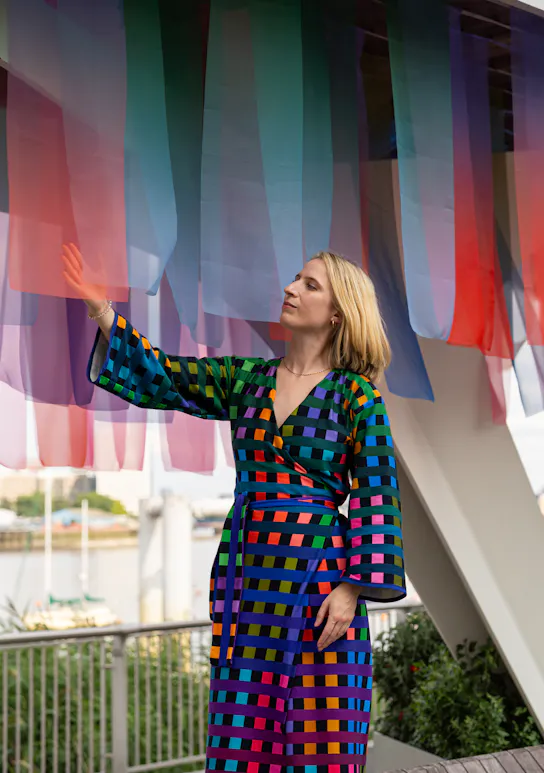
The received wisdom on certain colours, such as navy and taupe, being in good taste is “so limiting”, he says. Instead, Malone favours the kind of sparky blue and white, or yellow and black combinations seen on the signage for building sites, where he worked alongside his dad as a teen. He also thinks fashion illustration is, on the whole, pretty bad. “It’s quite idealistic and princess-y,” he says. “It doesn’t accurately follow the shape of most bodies; I don’t see the purpose of it.”

Of course, the fashion business has a long and ignoble tradition of distorting women’s figures, yet Richard isn’t following this course either. Rather than take one of the job offers he’s had from a big fashion house (“I’d probably be richer, but I’d be a lot less happy”), he prefers to work with a select group of private clients making expensive, one-off outfits. “I’m not from that background, where you’d have five grand to spend on a dress every few weeks,” he admits. “It’s a slow process of understanding their lives.”
He’s an admirer of these women, many of whom are great writers or performers, or run galleries or high-profile institutions, and says he’s learned a lot from them. Often they are in their 30s and 40s, have young children and need stunning outfits that can still be thrown in a suitcase or a washing machine. He can also see how, in certain ways, they’re like the women behind the market stalls back in Ireland.
“It’s really an exaggerated version of the same thing,” he says. “Presenting yourself definitely empowers both groups of women. It’s important for them to dress how they want to dress.”
“I have a problem with instagram. I don’t think you should offer access to work before it is fully realised. Students need a level of protection, as creatives.”

His new clients are supportive of Malone’s commitment to environmentally sound materials, such as Econyl, a type of synthetic fabric made in part from plastic fishing nets, or textiles from the high-end Italian mill Taroni, which has an excellent ecological credentials.
“As designers today, we need to make something that isn’t damaging,” he says. “You can change people’s buying patterns. You just need to give them a push.” All of this will be on display at Malone’s show at NOW Gallery, which runs 28 November-27 January. It will feature videos about the making of the fabrics, some of Richard’s own illustrations, plans for collections, half-finished clothes, and some garments-cum-sculptures, that visitors can fool around with. “A bit of everything really.”
He doesn’t want it to all be signposted and make perfect sense, because his work is quite erratic. And he’s adamant that the show, called Rinse, Repeat, is not a career retrospective. “I see it as a project, not a retrospective. After all,” he smiles, “I’ve only really been doing all this for three years.”
RINSE, REPEAT by Richard Malone is at NOW Gallery on Greenwich Peninsula until 27 January. nowgallery.co.uk