Space Invaders
Plenty of nocturnally minded urban professionals go to great lengths to plumb the depths of underground club culture, but few have gone as far as Simon Tracey, CEO of the Vibration Group. Earlier this year, a representative from his firm donned a hard hat and dropped down a derelict coal mine, to see whether there might be a way of turning the shafts into a viable venue.
“We couldn’t quite make it work,” he admits, “but we’ll look at any building, if we think it will create something interesting.” One of the Vibration Group’s biggest successes to date is Printworks London, a huge multi-storey, multi-purpose venue that Tracey helped co-found inside a cavernous old printing facility in Canada Water, back in 2017. “We’ve just been voted the ninth best nightclub in the world,” he says, “which is strange, really, because it’s not really a nightclub at all.”
Instead, Tracey understands that, when it comes to going out, today’s clubbers are looking for a bit more than a DJ booth, a bar and a dancefloor. “People don’t want to go to traditional clubs any more,” he says. “They’d rather have a party in an art gallery than in a nightclub.”
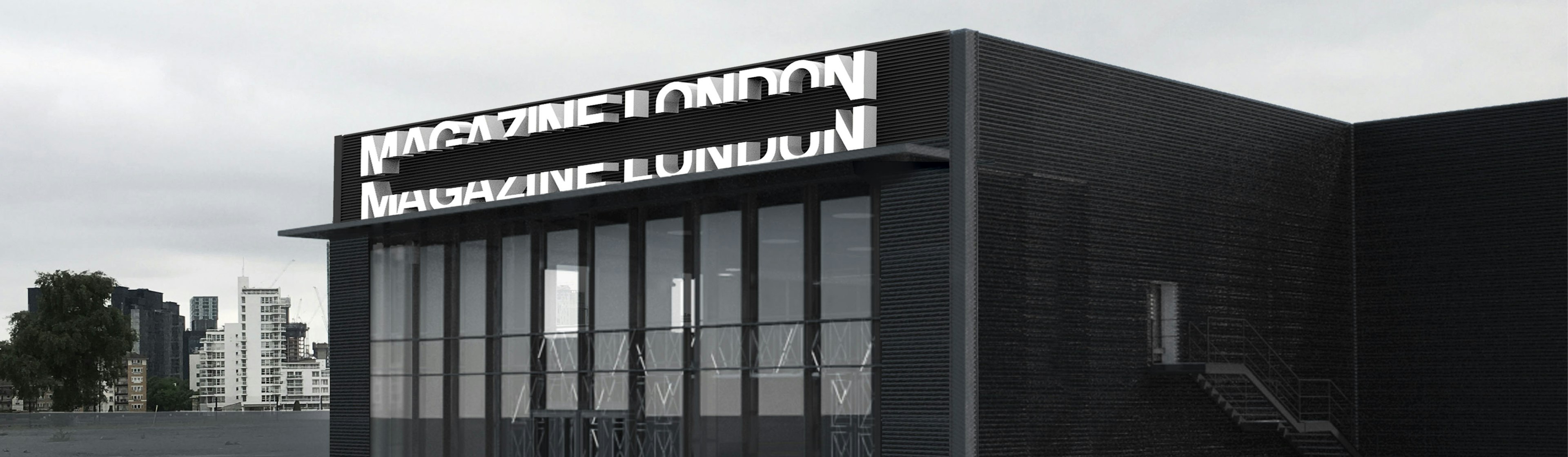
These days, Tracey sees his job as being less about fitting out soundsystems and stocking up beer fridges, and more about “creating an immersive event in a unique space”. With this in mind, his firm is just finishing off work on Magazine London, a new, multi-purpose, 24,179 sq m venue on the western shore of Greenwich Peninsula.


The new venue, designed by the London practice Nissen Richards – better known for working on exhibitions for the V&A, the British Museum and the Natural History Museum – is a deceptively simple series of more or less unadorned boxes, which can be reconfigured to suit everything from theatrical performances to awards ceremonies, as well as concerts, festival-type set-ups, product launches and, of course, club nights. “What we hope we created is a totally blank canvas,” he explains, “it’s all designed to be as multi-purpose as possible.
The building itself can accommodate 3,000, while the adjoining grounds can fit in another 7,000. It’s a huge block of real estate, yet the Peninsula’s developers, Knight Dragon, don’t plan to build permanent structures on this site for at least a decade. And in that furlough, Tracey and co are finding space and time to bring true cultural capital there.
“People don't want to go to traditional clubs any more. They'd rather have a party in an art gallery than in a nightclub.”
Of course, unused parts of London have been put to fairly creative uses for decades, sometimes without the owner’s consent. Some of London’s earliest warehouse parties took place in the Docklands, and Damien Hirst’s seminal group exhibition, Freeze, was staged in 1988 in an unused Port Authority building in Surrey Quays.
However, Tracey says the major difference between then and now is that, today both the club-going public and the developers understand the value in “worthwhile” rather than “meanwhile” projects.
“What we hope we created is totally blank canvas, it's all designed to be as multi-purpose as possible.”
“At one point, landowners were asking us to chuck something together,” he says, “but now we’re part of the masterplan.” Indeed, the new owners of an old embassy on Grosvenor Square have chosen to keep Tracey and his colleagues on to run the building as an events space, even though this was only supposed to be something of a stopgap. Clearly, London’s clubbers also appreciate a little backstory, as well as a sense of place. Tracey admits he’s become a bit of an amateur historian and is proud to reveal the thinking behind Magazine’s name.
“It’s on the site of an old munitions facility, so it speaks to the area’s industrial past,” he says, “But a magazine is also a repository for lots of different bits of content. So it’s a throwback to the heritage, but it will also absorb lots of different things in the future.”