The Art of the Possible
What can craft possibly have to offer in the face of the monumental task of tackling climate change? As the world’s leaders prepare to gather at COP26 to discuss what can be done on a global scale, we look at the case for small, independent designers as a harbinger of hope.
Craft as a tool in the fight against the climate crisis – really? I know what you’re thinking. Either you associate craft with Tom Daley’s poolside knitting, in which case you’re probably more than a little bemused, or you’ve seen independent designer-makers coming up with some pretty cool ideas, but you’re not convinced they’re scalable. Either way, craft is small; craft is marginal; craft is gentle. It hasn’t got the scope or seriousness to tackle the problems the planet is now facing, and certainly not at the scale we now need. “Independent designers with the greatest of intentions and the greatest of ingenuity are still the merest rounding errors of the real problem,” says craft historian Glenn Adamson. “The real problem is of such hugeness that it requires a radical rethinking of our production and consumption patterns as a species.” And he’s right. But what if craft – small, marginal and gentle as it might be – could help to prompt some of that radical rethinking?
Co-founder of Studio Swine Alexander Groves describes the Sea Chair that he and his partner, Azusa Murakami, designed as a “flight of fancy”. Inspired by the crafts practised by seafarers for generations, it was conceived to provide potential solutions to both the plastics crisis and declining incomes from fishing by providing fishermen with an open-source design they could make from ocean plastic while out at sea. However, he admits that they didn’t actually expect to solve either problem. So why design the chair at all? “Transforming the undesirable into something desirable makes you do a double-take and reassess your perception of the world,” he explains. “We wanted to bring [ocean plastic] to the public’s attention and introduce some poetry, which we felt was lacking in sustainable design at the time. We wanted to engage people with the issue and demand change in the way we use plastics.”


With director Juriaan Booij, Studio Swine made a film depicting a day boat heading out to sea in the romantic light of dawn. It shows fishermen catching both fish and plastic, turning the latter into Sea Chairs as they gut and prepare the fish. “The film was as important an outcome from the project as the chair itself,” says Groves. It went on to be awarded at the Cannes Film Festival and viewed by millions of people.
For Groves and Murakami, craft is not necessarily about fixing the planet’s problems, but about raising awareness of them with enough beauty to challenge perceptions and perhaps even spur the radical rethink that we need.
The argument often put forward in defence of such flights of fancy is that they serve as independent research projects, generating original ideas that, once proven, can be scaled up in collaboration with bigger companies – and sometimes this is the case. But what if this isn’t craft’s only role? “In the arena of poetics and persuasion, the designer is not necessarily coming up with the solution that will be scaled up and operationalised but rather using craft as a form of soft power – a way of getting people to attend to the problem of climate change and think in a more optimistic and hopeful way about potential solutions,” says Adamson.
“Craft offers an opportunity to create talismans of hope. Iconic, attention - grabbing, beautiful, charismatic objects can serve as handles on a possible future.”
Now that there’s unequivocal evidence that climate change is not only real but caused by human activity, and taking us on a path towards our own extinction, the communications task facing environmentalists is less driven by facts and more by emotions. The danger of reports such as this year’s IPCC’s Sixth Assessment is that the facts engender feelings of despair and hopelessness. If we are to reverse, halt, or even slow climate change, the task ahead of us is vast and can seem insurmountably complex. And it is intersected with issues ranging from biodiversity to social justice. It’s all too easy to feel completely overwhelmed, to bury our heads and to do nothing – but the crisis calls, more than anything, for action.
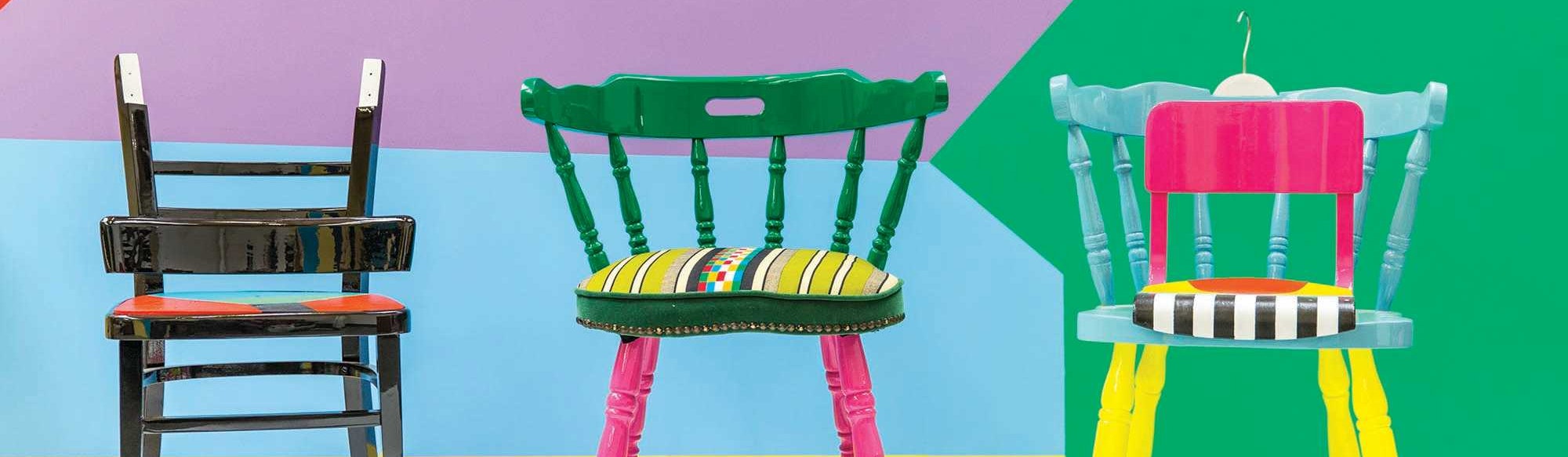
Craft offers an opportunity to create talismans of hope. “Iconic, attention-grabbing, beautiful, charismatic objects can serve as handles on a possible future – a future that is more functional, a future that actually works,” says Adamson. “Maybe the soft power of craft is most important because it gets right to our human understanding of the situation itself.” And if craft can create hope, it can inspire action, too. London-based designer Yinka Ilori agrees. “Storytelling is such a huge part of design; without a narrative, design is pointless,” he says. “It’s got to make me feel something.” Ilori’s If Chairs Could Talk project comprises five chairs, each made from the discarded pieces of others, which he uses to explore issues of both sustainability and social justice by telling the stories of five of his childhood friends. “I suddenly saw chairs not just as seats, but as objects that could explore power in society and, viewed in a gallery setting, perhaps even change perspectives,” he says.
Similarly, designer Simon Ballen tackles both the colonisation of his native Colombia and the waste and pollution generated by gold mining in his Suelo Orfebre (‘Golden Soil’) collection. His vessels and vases are hand-blown using recycled glass and ‘jagua’ – the crushed ore left over after gold mining. “I wanted to use design as a narrative medium that must stop striving to ‘mirror’ the coloniser, but instead to foster practices that make use of our own local realities, to create objects and tools for discourse and empowerment,” he says. He worked with the local community to develop the collection and, in doing so, demonstrated the value of something that was, until then, dumped into rivers at a rate of 100 tonnes a day, creating pollution downstream. “The people of the local community reacted with surprise to the transformation of the jagua,” he says. “They perceived it differently after the transformation. It was no longer a waste product but a material that could be transformed into something valuable. In the future, I would like to think that, metaphorically at least, every waste stream could be transformed into gold.”
“Artistic endeavour and wild leaps of creativity can sometimes lead to massive transformations in the way the material world operates and is understood,” says Adamson. And massive transformations are exactly what we’re looking for. Perhaps we’ve just been looking in all the wrong places – and the poetics of persuasion are rooted in the small, marginal and gentle after all.